

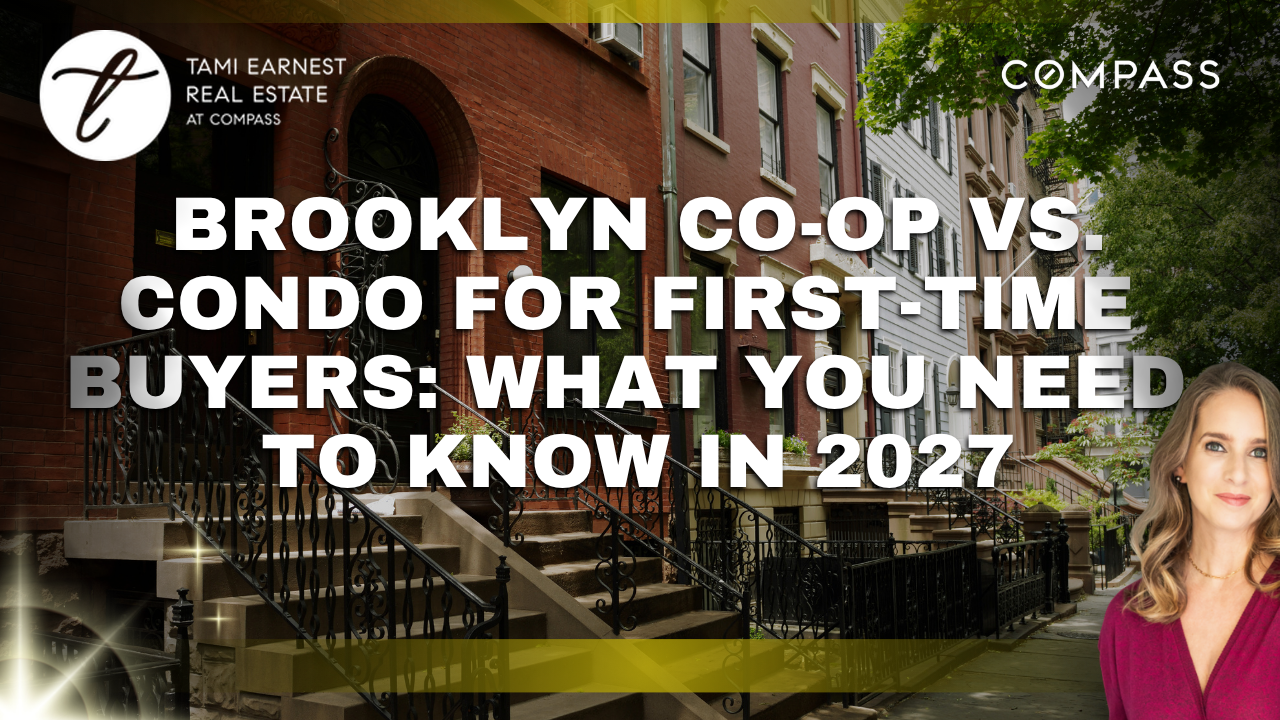
Brooklyn Co-op vs. Condo for First-Time Buyers: What You Need to Know in 2027

HomeBlogBrooklyn Co-op vs. Condo for First-Time Buyers: What You Need to Know in 2027
First-Time Buyer Guide
Brooklyn, NY
2027

Brooklyn Co-op vs. Condo for First-Time Buyers: What You Need to Know in 2027

The co-op vs. condo decision is the most important first choice a Brooklyn first-time buyer makes. Here is the honest 2027 breakdown — costs, board process, flexibility, and what each property type actually requires.

TE
Tami Earnest — Licensed Real Estate Salesperson, Compass
Published • Updated

Should a Brooklyn first-time buyer choose a co-op or a condo?

For Brooklyn first-time buyers in 2027, co-ops offer more choice and lower prices at the cost of a stricter approval process and less flexibility. Condos offer more flexibility and simpler transactions at a 20-30% price premium over comparable co-ops. The decision comes down to three variables: budget (co-ops extend it significantly), financial profile (co-op boards require specific DTI, down payment, and liquidity standards), and plans (buyers who may need to sublet or sell quickly within 3-5 years generally do better with condos). There is no universal right answer — the right choice depends on the specific buyer's situation.

The co-op vs. condo choice shapes everything about a first Brooklyn purchase. Here is the honest breakdown.

The Core Difference — What Each Property Type Actually Requires

A Brooklyn co-op purchase is the acquisition of shares in a cooperative corporation that owns the building, along with a proprietary lease giving you the right to occupy a specific unit. A condo purchase is the acquisition of real property — you own the unit itself. This legal distinction produces meaningful practical differences.

What a co-op requires that a condo doesn't: Board approval (submitting a full financial package, attending an interview, receiving a board vote); building-specific financial standards (down payment minimums, DTI thresholds, post-closing liquidity requirements that often exceed lender requirements); and ongoing maintenance payments that include a portion of the building's underlying mortgage. The board process adds 6-10 weeks to the transaction and introduces a rejection risk that condo purchases don't have.

What a condo provides that a co-op doesn't: No board approval requirement; more flexible financing (lower down payment options, more lender choices); easier subletting (most condos allow subletting with reasonable notice vs. co-ops which often restrict or prohibit it); and the ability to sell more freely without board consent. Condos are also real property, which means they can be financed with conventional mortgages and qualify for programs that co-ops can't.

For the board approval process specifically for first-time buyers, see the Brooklyn co-op board process for first-time buyers.

The Price Gap — What the Co-op Discount Actually Buys

Brooklyn co-ops trade at a 20-30% discount to comparable condos in 2027. On a first-time buyer budget of $600,000-$700,000, this discount is the difference between a studio condo and a one-bedroom co-op, or between a one-bedroom condo in a less desirable location and a one-bedroom co-op in an established building in a sought-after neighborhood. For first-time buyers whose budget is their primary constraint, the co-op discount is often the only path to the space and neighborhood they want.

The trade-off is the approval process and the ongoing restrictions. A first-time buyer in a co-op who discovers two years later that they need to sublet for a year (job relocation, new relationship, income change) will find most Brooklyn co-ops have strict sublet policies — often requiring board approval for subletting, limiting sublet terms to 1-2 years total over the life of the ownership, or prohibiting subletting altogether.

First-time buyers who are confident they'll stay for 5+ years and have the financial profile to pass a board are excellent co-op candidates. First-time buyers who are uncertain about their 3-year plans are better served by a condo, even at the price premium.

For the neighborhoods where the co-op discount produces the most first-time buyer opportunity, see Brooklyn neighborhoods for first-time buyers in 2027.

The Decision Framework — Which Is Right for You

The co-op vs. condo decision for a first-time Brooklyn buyer in 2027 resolves around three specific questions:

Question 1 — Does your financial profile meet co-op board standards? Specifically: do you have 20-25%+ for a down payment, a debt-to-income ratio within most boards' standards (typically under 30-35%), and significant post-closing liquidity (1-2 years of housing costs)? If yes, co-ops are a realistic option. If your finances are strong by lender standards but not by the tighter co-op board standards, condos are the more accessible choice.

Question 2 — What is your realistic holding period? If you're planning to stay 7-10+ years, the co-op restrictions matter less because you won't be triggering them. If you think there's meaningful probability of needing to sell or sublet within 3-5 years, the condo's flexibility is worth the price premium.

Question 3 — Does the co-op discount get you meaningfully more? If the co-op discount on your budget buys a one-bedroom instead of a studio, or a desired neighborhood instead of a compromise one, the discount is worth the trade-off. If the co-op and condo options at your budget are comparable in size and neighborhood, the condo's flexibility may be worth paying for.

For the honest agent perspective on this choice, see buying a Brooklyn co-op as a first-time buyer — my honest advice.

Frequently Asked Questions

Should a first-time buyer in Brooklyn get a co-op or a condo?
The right choice depends on budget, financial profile, and plans. Co-ops cost 20-30% less than comparable condos, but require meeting stricter board financial standards and accepting restrictions on subletting and resale. Condos are more flexible and straightforward but cost more. First-time buyers with strong finances, a 5+ year horizon, and a need to maximize their budget for space or neighborhood are well-suited for co-ops. Those with less certain timelines or who anticipate needing to sublet are better served by condos.
What is the price difference between co-ops and condos in Brooklyn in 2027?
Brooklyn co-ops trade at approximately a 20-30% discount to comparable condos in 2027. A comparable one-bedroom unit might be $550,000-$600,000 as a co-op and $700,000-$800,000 as a condo in the same Brooklyn neighborhood. This gap gives co-op buyers meaningfully more for their budget — more space, better location, or a better-maintained building than they could access in the condo market at the same price point.
Can I sublet a Brooklyn co-op as a first-time buyer?
Most Brooklyn co-ops have strict subletting policies — requiring board approval for any sublet, limiting the total number of years a unit can be sublet over the ownership period (often 1-2 years total), or prohibiting subletting entirely in some buildings. First-time buyers who are uncertain about their 3-5 year plans and may need to sublet should carefully review any co-op's sublet policy before purchasing, or choose a condo for the greater flexibility.
What are the monthly costs of a co-op vs. condo in Brooklyn?
Monthly costs differ between property types. Co-op owners pay maintenance (covering property taxes, building expenses, and underlying mortgage payments) plus a separate financing payment if applicable. Condo owners pay common charges (building expenses) plus property taxes separately plus their mortgage. In practice, the total monthly cost is often similar between co-ops and comparable condos, with the co-op's lower purchase price often offsetting the comprehensive maintenance structure.
Do first-time buyer programs apply to Brooklyn co-ops?
Most first-time buyer programs (SONYMA, Fannie Mae HomeReady, Freddie Mac Home Possible) apply to condos but not co-ops, because co-ops are shares rather than real property and don't qualify for conventional mortgage products. First-time buyers pursuing these programs should focus on condo properties. Buyers specifically targeting co-ops should inquire with lenders about co-op financing options, which are separate products from standard residential mortgages.
Thinking About Your First Brooklyn Purchase?
I work with first-time buyers in Brooklyn every week. Happy to give you an honest read on what your budget reaches and what the process actually involves.

Buyer Resources

The co-op vs. condo decision for Brooklyn first-time buyers in 2027 turns on three questions: does your financial profile meet co-op board standards (20-25%+ down, conservative DTI, 1-2 years post-closing liquidity), what is your realistic holding horizon (co-op restrictions matter less over 7-10 years), and does the 20-30% co-op discount buy you meaningfully more in space or neighborhood? First-time buyer programs typically apply only to condos. Subletting restrictions make condos the better choice for buyers uncertain about their 3-5 year plans.

There is no universally right answer between co-op and condo for a first-time Brooklyn buyer — the right answer depends on your specific financial profile, timeline, and budget need.

Tami Earnest is a Licensed Real Estate Salesperson with Compass, serving Manhattan, Brooklyn, and Westchester County. 14 years, 1,300+ transactions, $164M+.
View full profile →
Tami Earnest
Tami Earnest
Licensed Real Estate Salesperson
Compass | Manhattan · Brooklyn · Westchester

Buyer Resources
202.528.4215

Check out this article next

How Much Do You Need to Save to Buy in Brooklyn? The 2027 Breakdown

How Much Do You Need to Save to Buy in Brooklyn? The 2027 Breakdown

Home › Blog › How Much Do You Need to Save to Buy in Brooklyn? The 2027 BreakdownFirst-Time Buyer GuideBrooklyn, NY2027How Much Do You Need…

Read Article